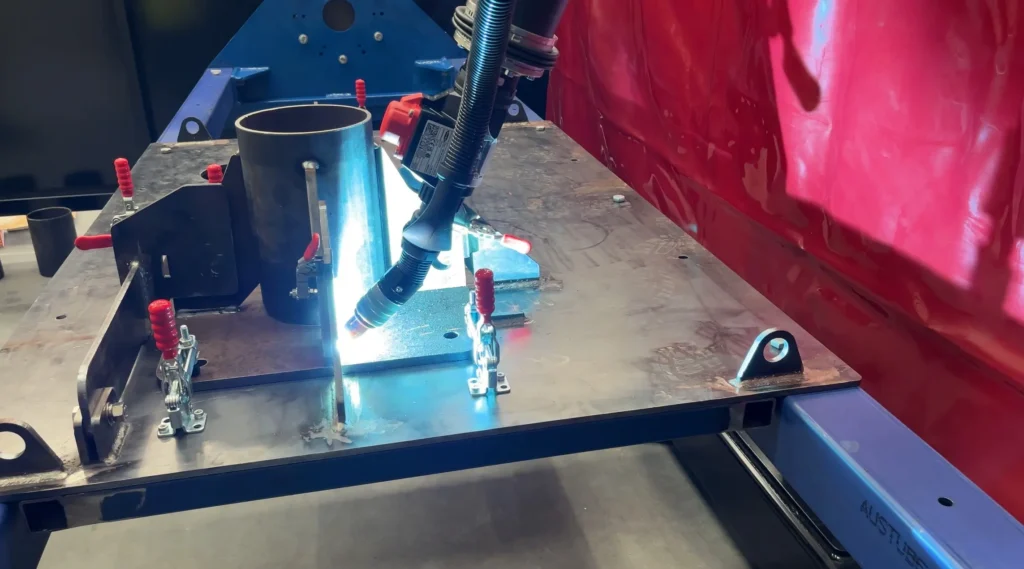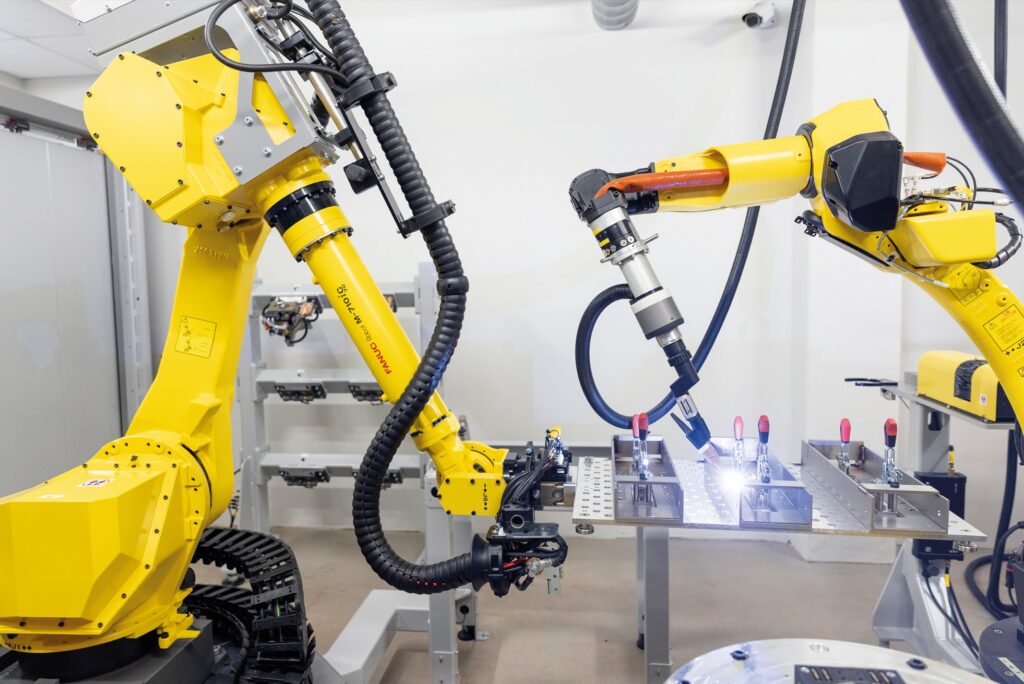
TIG welding produces some of the cleanest, most precise welds, but it is also one of the slower, and more demanding processes to automate successfully. Manual TIG welding gives a skilled welder precise control over heat input, arc characteristics, and filler addition. This makes it a popular choice for a wide range of applications where the aesthetics of the weld are as important as the performance.
It’s natural to want to stick to what you know when considering moving to automated welding. However, it’s also important to consider how well your preferred welding process translates for your specific applications when automated.
This article is a practical guide to robotic TIG welding. It will cover what it is, where it excels, where its limitations lie, and how to select the right process for your applications.
What is Robotic TIG Welding
TIG welding, also known as Tungsten Inert Gas welding or Gas Tungsten Arc Welding, uses a non-consumable tungsten electrode to generate the arc. An electrical arc forms between the tungsten tip and the workpiece to melt the base material, an inert gas then flows through the torch to protect the hot tungsten and molten puddle from contamination.
In manual TIG welding, the welder controls torch position and travel speed while managing arc length and heat input. Filler metal is added separately when required. A foot pedal or torch control may be used to adjust current, depending on the setup.. The final product depends heavily on the skill level of the welder.
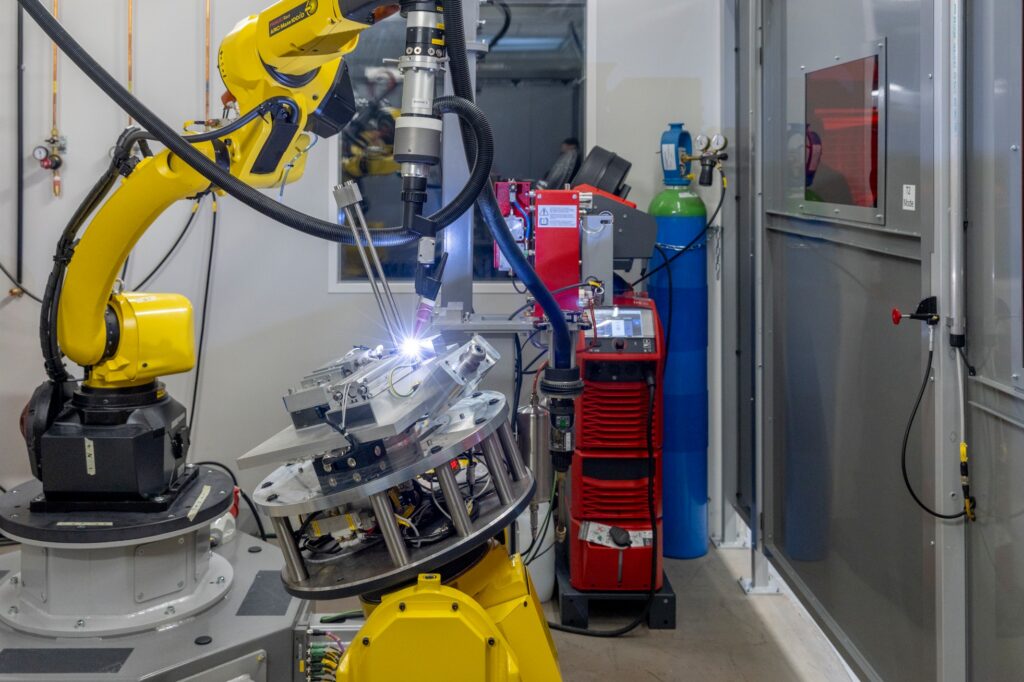
In robotic TIG welding, the robot controls torch position and travel speed along a programmed path. The welding power source controls current and any programmed pulse characteristics. Filler wire can be fed automatically when required, using a torch-mounted guide or a separate feed arrangement.
A robot can repeat its programmed path consistently, but repeatability alone does not correct for changes in part location or joint geometry. Touch sensing, seam tracking or other adaptive features can compensate for some variation when they are included and configured for the application.
Where Robotic TIG Welding Works Well
Robotic TIG welding is ideal for a wide range of applications, including:
- Appearance-Critical Welds: TIG can produce clean welds with very little spatter and precise control of bead size and profile. It may suit applications where visible weld appearance matters, although the result also depends on the material, joint, procedure and any post-weld finishing.
- Thin Materials and Heat-Sensitive Applications: TIG can provide precise control of the arc and weld profile, which can be useful on thin material or where controlled penetration is required. It is not automatically the best choice: suitable pulsed MIG processes can also weld thin sheets. Compare welding procedures and trial welds for the actual material, joint and fit-up.
The Limitations of Robotic TIG Welding
Even if you’ve been using TIG welding processes manually for years, that doesn’t always mean that it is the right choice for robotic welding systems. Robotic TIG does have some limitations to consider when selecting the right setup:
- Speed: TIG systems are relatively slow, and in robotic welding, where arc-on time directly determines throughput and cost per weld, a slower system can directly correlate to higher costs across the entire production line.
- Part Fit-Up Requirements: TIG often requires consistent fit-up because small gaps can be difficult to accommodate. Some MIG procedures may bridge certain gaps more readily because filler wire is added continuously, but tolerance depends on the joint, material and process settings. Neither process removes the need for suitable part preparation and fixturing.
Choosing the Right Robotic Welding Process
Once manufacturers make the first difficult choice about whether to automate their processes, the next big question becomes which process should their robotic welding systems use. When selecting the right welding process, the natural starting point should be the application, consider: materials, joints, thicknesses, finish requirements, and production volume.
TIG and MIG are the two most common options, and the choice you make determines the system configuration, throughput capacity and overall cost per weld.
| Robotic TIG Welding | Robotic MIG Welding | |
| Typical Strength | Precise control of weld size, shape and penetration | Often higher deposition and travel rate |
| Possible applications | Thin sections, controlled root passes, or applications with demanding appearance requirement depending on the procedure | General fabrication and applications prioritising production rate |
| Weld appearance | Typically produces very little spatter and can provide precise control of the weld profile | Appearance varies by process and settings; some advanced processes produce low-spatter, attractive welds |
| Fit-up | Requires controlled preparation and fit-up | Filler wire may help with some joint gaps, but fit-up still matters |
| Selection | Depends on material, joint, procedure, quality requirements and cycle time | quality requirements and cycle timeDepends on the same factors, plus the suitable wire and transfer mode such as Pulse or CMT |
Is Your Application Right for Robotic TIG?
Robotic TIG welding is likely a strong fit for your production if:
- Your application requires controlled penetration or involves thin material. Thickness alone does not determine whether TIG or MIG is the better process; assess the material, joint, fit-up and required weld quality.
- Weld appearance is a primary specification. Some advanced MIG processes, including Fronius CMT in suitable applications, can produce low-spatter welds with an attractive profile. The result depends on the material, joint and welding procedure.
- Part preparation is consistent, fit-up tolerances are tight and controlled, and surface condition is reliable
- Joint geometry is accessible to the TIG torch without requiring positions that compromise shielding gas coverage or filler wire delivery
- The weld has demanding quality or inspection requirements. Select and qualify the process against the applicable specification and welding procedure; robot or process choice alone does not guarantee weld quality.
If you’re still unsure which process is best for your specific applications, our experienced team at Infinite Robotics can provide tailored advice.
How Infinite Robotics Approaches Process Selection
At Infinite Robotics, we are committed to making sure every robotic welding system performs consistently, delivers the quality your application requires, and keeps performing that way across its operational life.
This means that when we recommend a welding process it is guided by your applications. Our first step is understanding the material, the joint, the volume, the finish requirement, and the consistency of your incoming parts. We will then assess whether TIG or MIG, or even laser welding is best suited for your needs.
We then design and integrate the complete robotic welding system, including the robot, power source, wire feed, fixturing, and programming, and ensure every component is configured specifically for the required applications.
Streamline Your Production Line with the Right Welding Process
Robotic TIG welding is a precise, capable, appearance-quality process that earns its place in a specific set of applications. If you frequently work with thin materials, exotic alloys, high-specification low-volume production, and situations where weld finish quality is a primary requirement then robotic TIG welding may be the perfect solution to enhance your production line.
If you’re considering a robotic welding system, contact Infinite Robotics. Our experienced team can help design a high-functioning custom welding system specifically for your applications.