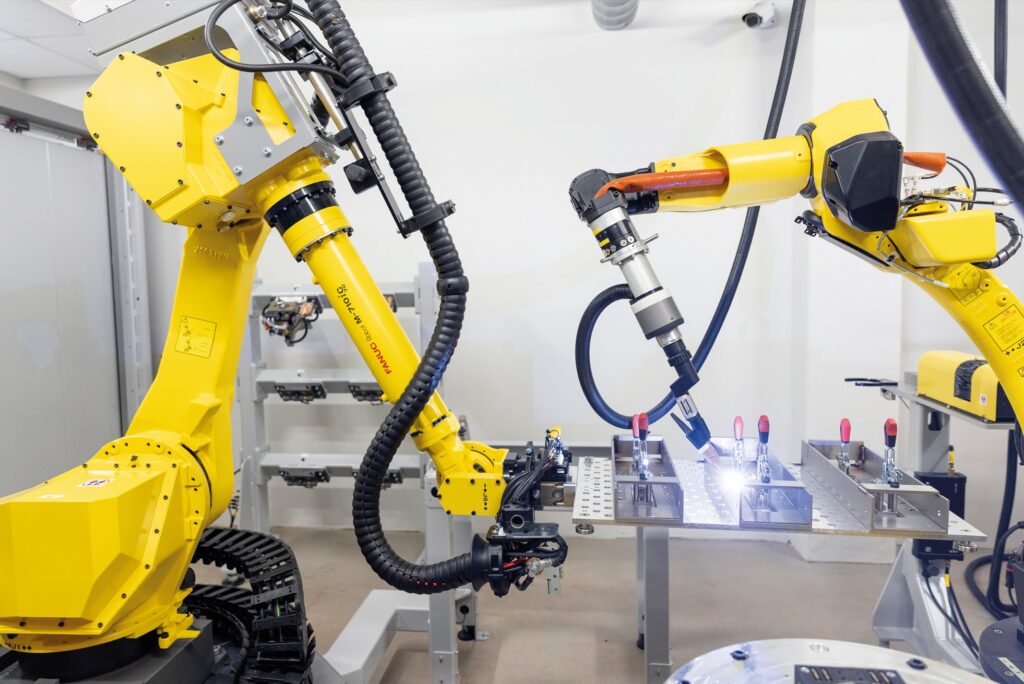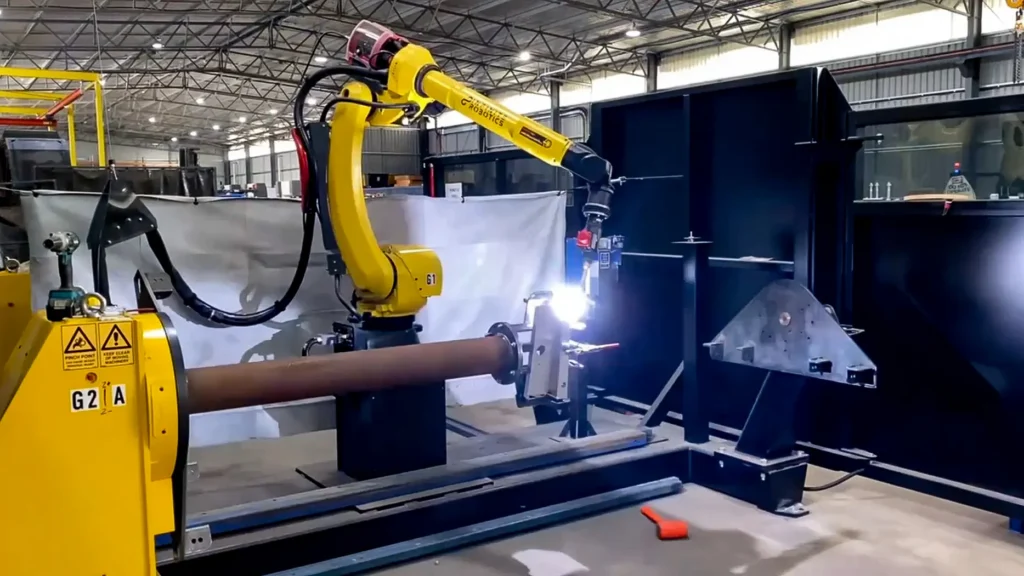
It is commonly believed that welding automation is only for high volume, but this is now a misconception. The truth is, with the introduction of collaborative welding robots,flexible robotic welding systems and offline programming, welding automation can now help transform production lines for all manufacturers, regardless of whether you handle a wide variety of different parts or a handful of similar parts.
This article will explore the traditional challenges associated with automating high mix, low volume production, how cobots have changed the landscape, what conditions you need to successfully adopt them, and how Infinite Robotics can help.
Why High Mix, Low Volume Is Believed to be Hard to Automate
Traditional industrial robot cells were built for long production runs, requiring weeks of programming and dedicated tooling. This meant that programming them to handle a wide range of unique parts was not cost or time efficient, especially if there was only a small run required. It was much more efficient for skilled welders to handle these small batches manually than dedicate the time and resources required to program the systems.
This means these industrial robot cells were mainly only adopted by businesses with high volume production where they were handling large batches of similar parts that could be continuously repeated using one program. This meant that smaller fabricators and manufacturers missed out on the benefits of robotic welding.
The Importance of Finding a Solution
Even small batches can add up over time, especially as we are facing skilled labour shortages and rising costs. Continually leaving skilled welders to carry the entire work load can quickly lead to bottlenecks in production and quality that varies between welders and shifts adding further costs not just in delays but also in rework.
It’s clear that these businesses needed a solution as well. This is where collaborative welding robots and flexible robotic welding systems come in.
How Cobot Welding and Flexible Robotic Welding Systems Changed the Game
Collaborative welding robots and flexible robotic welding systems offer a powerful solution for manufacturers with high mix, low volume requirements. These automated welding systems were specifically designed to work alongside skilled welders, helping to streamline production lines, regardless of mix or volume.
These systems feature simple, user-friendly programming through hand-teaching and drag and drop tablet interfaces, allowing skilled operators to learn the programming quickly and program the cobots from day one, removing the time drain associated with traditional industrial welding robots. Each program can also be saved and stored in the robot and recalled for repeat jobs; even if it is a small batch, the time savings will still be noticeable.
Cobots are also designed to be compact and moveable, making them ideal for the tight workspaces.
How Welding Automation Handles Constant Change
Collaborative welding robot systems are perfectly positioned to handle the constant change associated with high mix, low volume production through various key features:
Fast and Flexible Programming
Hand-guided teaching and intuitive, icon-based, drag and drop programming makes programming cobots accessible and efficient for all skilled welders. There’s no code to learn; the program is designed based on recognisable smart phone icons so any operator who uses a smart phone should be able to pick up the program quickly. This means that programs can be created quickly and easily; perfect for handling a wide range of unique parts.
Once the robot is taught, programs can be saved and recalled as necessary to deliver repeatable production. It also frees up skilled operators to focus on more complex tasks while the cobot handles the repetitive welds.
Repeatable Fixtures and Fast Changeover
The robot arm cannot reposition a part the way a skilled human welder can, this is where fixtures come in. Fixtures ensure the part goes in the exact same position every time, ensuring the program runs correctly. This allows for faster changeover as you know exactly where the part needs to be, when welding the same parts.
Cobots feature modular and reconfigurable fixturing approaches to support accurate part placement and fast change over. Whether you opt for base plates, locating pins or quick-clamp systems, it’s important to consider the right fixturing approach for your production needs. In high mix, low volume production, you need fixtures that can be quickly and easily reconfigured for different parts and welds.
Touch sensing capabilities and automated positioners can also assist with ensuring the part is in the correct position for the programmed weld. Touch sensing automatically identifies the location of parts to adjust the position of the arm, while positioners move parts as the cobot welds to ensure the part is always presented to the robot arm and welding torch at the right angle and allowing for continuous operation.
Operator-Assisted Workflows
Cobot welding systems were designed to assist operators, helping to fill a gap created by worldwide skilled labour shortages. Skilled welders program the cobot, place the part and then press play, allowing the cobot to handle the repetitive jobs, while they focus on more complex or one-off jobs that don’t suit automation.
This extends the capabilities of your existing team without replacing them and without requiring you to expand your workforce from a shrinking talent pool.
Reduced Rework
Automated and repeatable programming means that the cobot delivers the same weld every time. This removes the risk of mistakes or faults caused by human error, fatigue or lack of skill. Cobots deliver high-quality, reliable results time after time, reducing the need for costly and time consuming rework.
This is especially beneficial for low volume runs where a single defective part is a major part of the run.
What You Need for Success in High Mix, Low Volume Manufacturing Settings
Welding automation with cobots is a major breakthrough for the manufacturing sector and businesses with high mix, low volume runs. However, there are a few things that businesses need to consider when adopting welding automation:
- Reliable Part Fit-Up and Fixturing: Robots weld where the program tells them to, so if gap and alignment vary between parts, the weld quality will too. Reliable fit-up capabilities are essential for ensuring the part is always in the correct position for the programmed weld. However, touch sensing capabilities and positioners built into the cobot system can also assist with this process.
- Clear Production Goals: Consider what the cobot is really required for to confirm whether it will actually suit your production line. Is it to address a bottleneck in production, a quality problem, a labour gap, or all of the above? By knowing your goals you can measure the ROI welding automation will deliver over time and whether it’s cost effective.
- Realistic Part Selection: Consider the parts that you actually need to weld and whether the cobot is the best solution. For example, cobots are ideal for consistent joint types, accessible welds, and moderate sizes, but may not be as effective or efficient for one-off prototypes, heavily distorted assemblies, and joints with very poor access; these jobs are best suited for skilled human welders. However, if these parts are only a small part of your production, cobots can handle the rest, freeing more time for your skilled welders to focus on these tasks.
At Infinite Robotics, we can work with you to answer these questions and design a collaborative welding robot tailored to your production needs.
Streamline Your Production Line with Welding Automation
Forget the misconception that welding automation is only for low mix, high volume requirements. Cobot welding systems change the game, making automation ideal for most manufacturers, even those with high mix, low volume needs, acting as an extension of your team to expand your capabilities without growing your headcount.
Talk to the Infinite Robotics team about your production needs and we’ll tell you honestly whether and how welding automation fits in, and design a cobot tailored to optimise your productivity.