You’ve likely heard the term ‘robotic welding machine’ before, whether from a competitor, trade show or in an article online. But do you truly understand what it is?
The term gets thrown around frequently, especially when searching for ways to address skill shortages, tight deadlines, and scalability without increasing headcount. The truth is, robotic welding machines are great for all of that. They are a powerful addition to any production team, offering a complete system that delivers consistent, repeatable, high-quality welds at a speed.
To help remove any confusion, today we will explore exactly what robotic welding machines are, the components they are made up of, the common welding processes they offer, and how they can fit into a production line.
The Short Answer: What a Robotic Welding Machine Is
Simply put, a robotic welding machine is an integrated system that uses a programmable robotic arm to guide a welding torch along a defined path, applying a welding process to join metal components automatically and repeatedly.
Robotic or automated welding machines are designed to streamline and speed up the labour-intensive, time-consuming and repetitive production processes. They don’t replace experienced welders, they learn from and work with them, automating the repetitive work and freeing them up to handle the more complex tasks.
They follow pre-programmed instructions from your team that specify exactly where to weld, at what speed, with what parameters, and in what sequence. They then execute that programming consistently to produce high quality results every time without fatigue, mistakes, or complaints.
The Components of a Robotic Welding Machine
To truly understand what a robotic welding machine is, you need to understand the components that it’s made up of. Each component plays a critical role in delivering high-quality precision and consistent results.
Robotic welding machine components include:
- Robotic Arm:
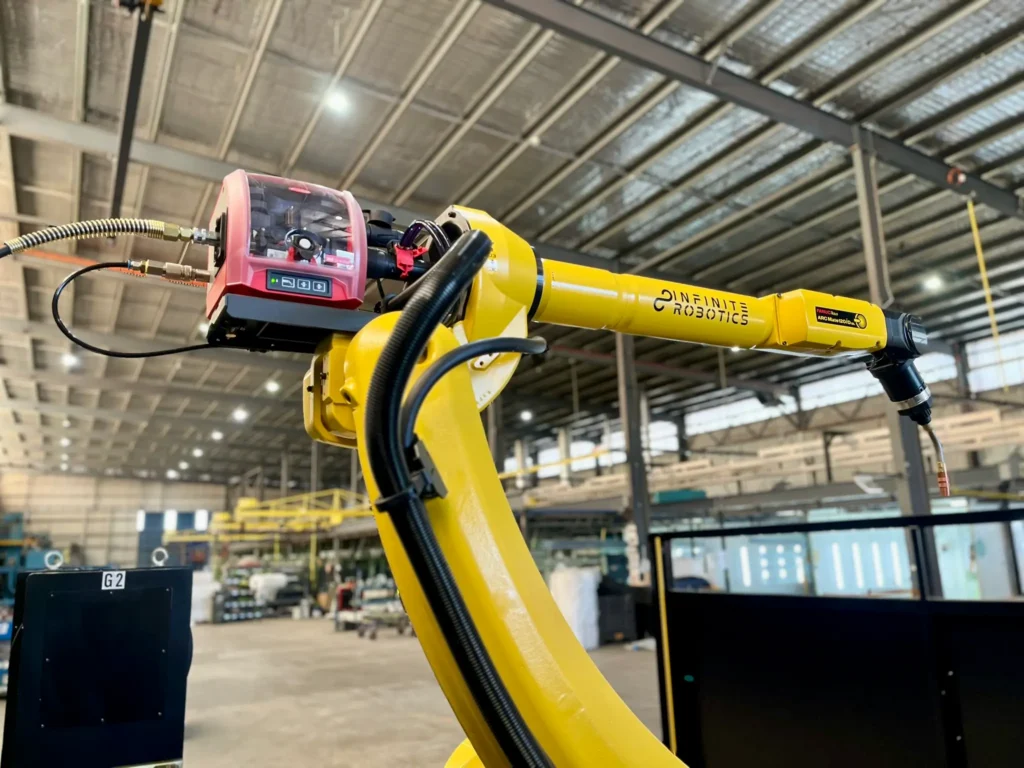
This is the mechanical structure that moves the welding torch through the programmed weld path. They have motorised joints at each axis that allow the torch to be positioned in virtually any direction within the robot’s working envelope to deliver the perfect weld. They are available in a wide range of sizes, reaches and payload capabilities to suit specific applications. FANUC have the largest range of robot arms in the world and are known for their reliability, precision and support. - Welding Power Source:
This is the component that generates and controls the electrical arc that melts the base metal and filler wire to create the weld. It delivers precise, consistent electrical output to meet programmed parameters. They come in a variety of amperage options to suit materials, cycles, and welding processes.Two of the leading welding power source brands include Fronius and Kemppi. - Welding Torch:
The welding torch sits at the end of the robotic arm and is the tool responsible for the actual welding. Welding torches come in various shapes to suit complex joint geometries. They also offer various advanced features to enhance safety and efficiency, such as collision detection technology and automated torch cleaning and maintenance systems to remove spatter build-up from the nozzle. - Wire Feeder:
The wire feeder is the component that delivers filler wire from the spool to the torch at a controlled, consistent speed, as specified in the programming. Wire feeders come in push, pull, and push-pull configurations to suit different wire types and torch lengths. - Robot Controller:
This is effectively the brain of the robotic welding machine. It is the computing hardware and software that stores the robot’s programs. The robot controller is responsible for executing motion commands, coordinating with the welding power source and other system components, and managing safety functions. - Fixtures and Tooling:
Fixtures are the tooling that holds components in the correct position and orientation for welding. They ensure that the arm and torch are in the right position to ensure precise welds. They are responsible for delivering consistent, repeatable and accurate welds every time. - Positioners:
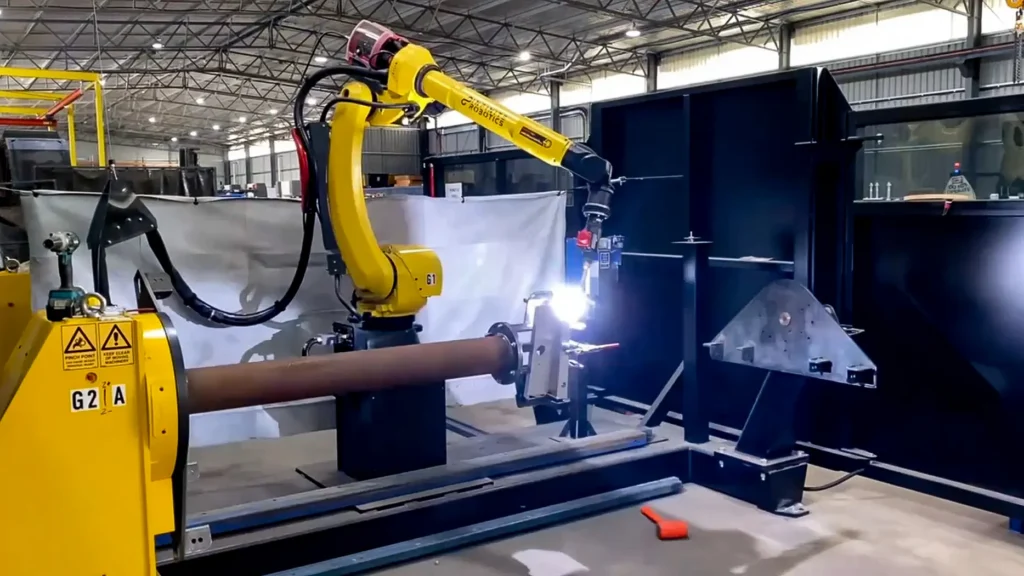
This is a motorised device that rotates or tilts the component being welded. This allows components to be rotated automatically to ensure that it is in the optimal position for the welding sequence. Positioners can be single-axis–rotating around a horizontal axis–or dual-axis–to tilt and rotate on multiple planes. - Safety Systems and Guarding:
These are the mandatory safety features that protect operators and operations. Typical safety architecture includes perimeter guarding, light curtains, and on-torch fume extraction. - Programming Interface:
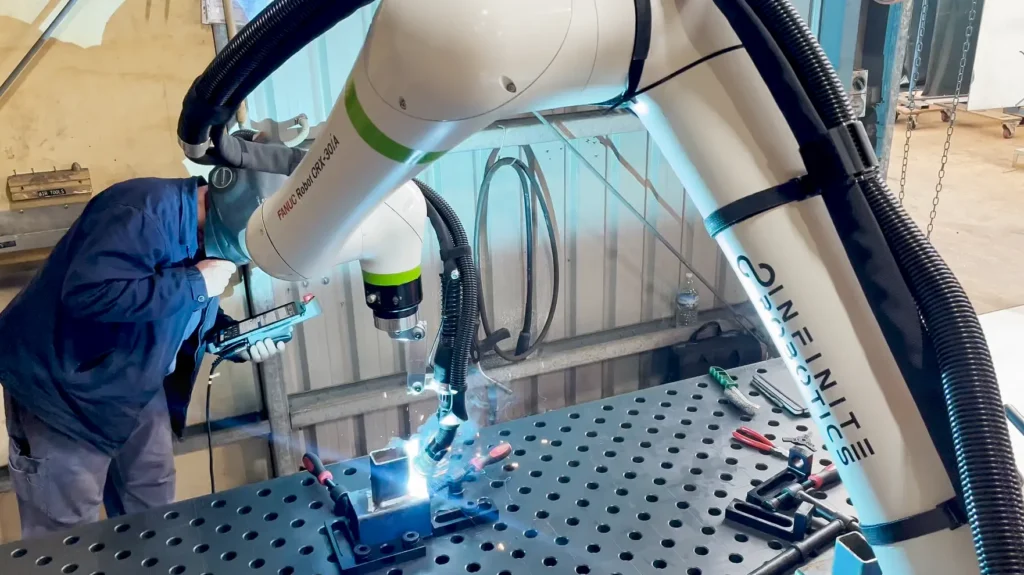
The programming interface is the system engineers and technicians use to create, modify, and manage the programs that the robotic welding machine executes. This can include a teach pendant handheld device to move the robot manually and record positions for fine-tuning and minor adjustments. They can also provide offline programming software which allows technicians to develop programs in a CAD-based simulation environment, and then load them onto the robot controller without requiring the physical system to be taken offline.
How it Comes Together: Automated Welding Machine Cycle
All of these components work together to deliver a streamlined welding cycle.
- The operator loads the component into the fixture, which locates and clamps it in the programmed position. The positioner then moves it into position for the first weld.
- The operator then selects the correct program and the robot controller confirms safety system status before the robot arm moves into position for the first weld.
- The robot then signals for the welding power source to initiate the arc welding process. The wire feeder will begin feeding wire at the programmed speed, the shielding gas will flow and the arc will stabilise.
- The welding process will then start. The robotic arm moves the torch along the programmed weld path while the positioner moves simultaneously to maintain optimal angles.
- Once the system reaches the programmed weld end point the power source will terminate the arc.
- It will then transition to the next weld, repeating steps 4 and 5 for every programmed joint.
- Once the cycle is complete, all components will return to home or load position to prepare for the next task. The operator can then unload the component and load the next to repeat this cycle.
Common Welding Processes
Automated welding robots can be engineered to deliver different welding processes depending on your needs. The most common welding processes include:
- MIG/MAG Welding:
Metal Inert Gas (MIG) or Metal Active Gas (MAG) welding processes deliver a continuous wire feed that is fast and versatile. It is best suited to mild steel, stainless steel, and aluminium. These processes are well suited for automated welding machines as they offer a high deposition rate, good gap-bridging capability, and clear parameters.
Fronius also provides advanced MIG variants, such as pulsed MIG and CMT (Cold Metal Transfer), to deliver superior control, lower heat input, and cleaner welds for demanding applications. - TIG Welding:
Tungsten Inert Gas (TIG) welding is a slower, lower-deposition process that produces clean, high-quality welds. This process is best suited for thin materials, exotic alloys, stainless steel, and applications where appearance, precision, or material sensitivity is important.
What Makes a Robotic Welding Machine a Complete Solution?
A robotic welding machine is a collection of components that act as a complete, production-ready solution. This means you can use it immediately after installation and training, delivering results from day one.
At Infinite Robotics, we deliver tailor-made, turnkey robotic welding machines that you can use straightaway. We work with you to select the right components based on your unique production needs and challenges. We then assemble and install a ready-to-use solution on-site. We also provide dedicated training and ongoing support to help you get the most out of your automated welding machine.
Is a Robotic Welding Machine Right for Your Business?
Investing in welding automation and robotic welding equipment is a great way to streamline your production processes and address headcount and experience challenges without sacrificing quality or consistency. Robotic welding machines handle the repetitive projects, delivering precision and consistency every time, while your experienced technicians focus on the more complex tasks.
Here are a few reasons why many businesses choose to invest in welding automation:
- Struggling with skilled labour shortages
- Ambitions to scale without increasing headcount
- Reliable weld quality and consistency
- Handling high-mix, low-volume requirements
- Tackling repeatable tasks and redirecting experienced staff
So, if you have high-mix, low-volume welding needs, are struggling to find skilled labourers, and want to scale your operations, robotic welding machines might be perfect for you.
At Infinite Robotics, we provide tailored solutions to meet your unique needs. Contact us today to discuss your welding needs and find out if a robotic welding machine could fit into your production team.