Investing in robotic welding is a significant decision for any manufacturer. The upfront investment must be considered alongside production requirements, labour availability, weld quality, future capacity and the expected return on investment.
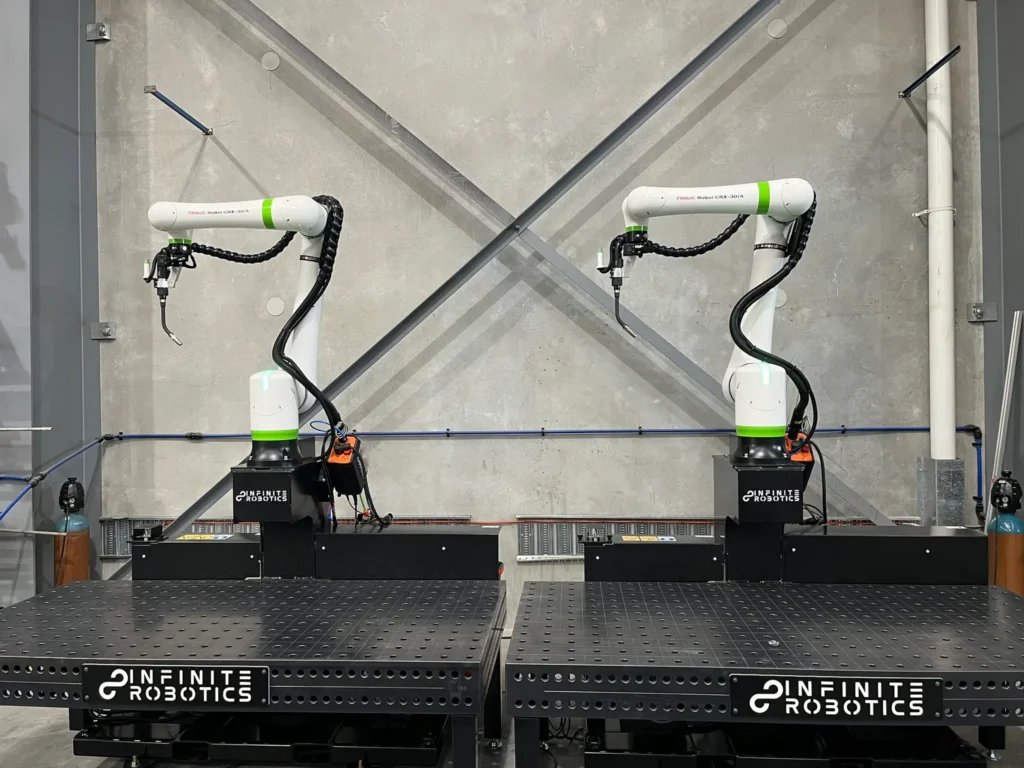
The short answer is that the cost of a welding robot depends on the complete system, not just the robot arm. A fixed cobot with manual loading, a welding table and simple jigs will generally sit at the lower end of the investment scale. Engineered fixturing, positioners, longer reach, seam sensing and multiple workstations move the investment upward. A fully guarded industrial cell with external axes, more complex programming and higher production requirements sits higher again.
Because these requirements depend on the parts being welded and the required production output, a generic price can be misleading. This guide explains what moves the cost of a welding robot up or down, what should be included in a turnkey quotation, how cobot and industrial systems compare, and how to assess the potential return on investment.
What Determines the Cost of a Welding Robot
The cost of a robotic welding system is primarily determined by the application. The most important factors include:
- Part size, weight, geometry and weld accessibility
- Material, thickness and welding process
- Part-to-part consistency and fit-up
- Production volume, product mix and changeover frequency
- Robot type, payload and reach
- Welding power source and process capability
- Fixturing and jig requirements
- Positioners, tracks and other external axes
- Seam finding, tracking and offline programming
- Safety, guarding and fume-control requirements
- Delivery, installation, commissioning and training
- After sales support
These factors do not affect the cost equally. A change in part size, weld access or the way a component must be presented can alter the entire system concept, while other options may affect only one item of equipment. The most reliable way to compare costs is on a like-for-like, turnkey basis.
Typical Levels of Welding System Investment
The following categories show how system complexity generally affects the required investment without relying on a generic price that may not apply to the application
| System Type | Typical Configuration | Relative Investment |
| Small cobot with air cooled welding system | Fixed cobot, manual loading, robotic MIG/MAG package, welding table, simple jigs and a limited range of parts | Lower |
| Production-focused cobot system | Larger reach, engineered jigs, water-cooled torch, dual stations or a positioner, additional sensing and more safety integration | Moderate |
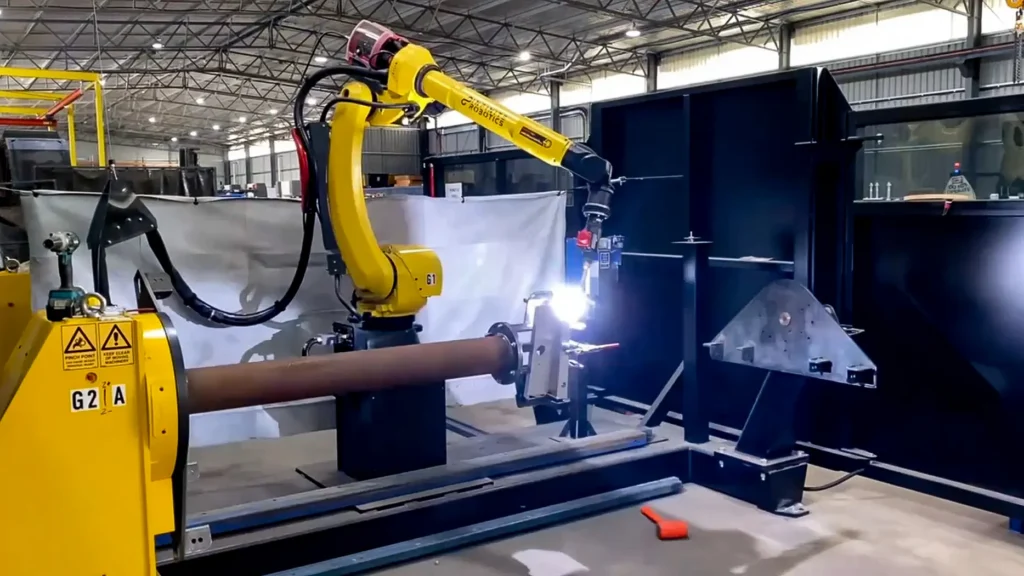
| Industrial robotic welding cell | Industrial robot, larger or heavier parts, servo positioners or tracks, multiple stations, full guarding and more advanced programming | Higher |
These categories are only a guide. A complex cobot system can cost more than a relatively simple industrial cell once positioners, tracks, engineered fixturing, guarding or advanced sensing are added.
The Robot
The robot arm and controller are only one part of the complete system and are not always the largest cost component. Reach, payload, mounting arrangement, environmental protection and integration with external axes all influence the robot selection.
Selecting the lowest-cost robot can create higher costs elsewhere if additional repositioning, a longer track or more complex fixturing is required to compensate for limited reach or payload. Conversely, purchasing significantly more capacity than the application requires can tie up unnecessary capital. The robot should be selected around the current application while allowing capacity for future work.
Robot brands can appear similar when compared on purchase price, payload and reach, but there can be significant differences in reliability, maintenance requirements, product lifecycle and the level of support available in Australia. A lower upfront price may be offset by more frequent maintenance, limited local technical support, long waits for spare parts or difficulty obtaining support later in the robot’s life.
Before selecting a robot brand, buyers should consider:
- Whether the manufacturer has an established Australian service operation
- Availability of locally based technicians
- Availability and lead time of critical spare parts
- Preventive maintenance requirements and expected operating life
- Warranty coverage and who is responsible for providing it
- How long the manufacturer intends to support the robot and controller
- Availability of software updates, backups and remote diagnostics
- Whether the integrator has proven experience with that robot platform
The true cost of a robot therefore includes more than its purchase price. Planned maintenance, spare parts, technical support, software continuity and the cost of production downtime should all be considered when comparing brands.
Infinite Robotics is a FANUC authorised integrator and uses FANUC robots because we value their industrial design, established Australian service presence, spare-parts support and long-term platform continuity. This manufacturer support is combined with Infinite Robotics’ own local integration, training and ongoing technical support.
The Welding Power Source
The welding power source is another significant part of the package and is frequently underestimated. Selection should be based on material, thickness, wire type, required welding process, duty cycle, data requirements and the level of integration with the robot.
Entry-level robotic power sources may be suitable for standard MIG/MAG work. More advanced systems, including solutions from Fronius and Kemppi, can provide pulse processes, advanced arc control, aluminium and stainless-steel capability, parameter monitoring and production data connectivity.
A lower purchase price does not always produce a lower whole-of-life cost. The correct power source should deliver the required weld quality and duty cycle without including expensive processes or features the business is unlikely to use.
Infinite Robotics selects the welding process around the customer’s materials, weld requirements and production needs—not simply the lowest-cost equipment package. Where required, welding trials can be completed on representative materials or parts before the final system is specified. This reduces the risk of investing in equipment that cannot achieve the required weld quality or production outcome.
The Torch, Wire Feeder, and Consumables Infrastructure
The welding torch, wire feeder, mounting hardware and consumables must be matched to the robot, power source, material and required duty cycle. The main cost and whole-of-life considerations include:
- Torch bodies with collision detection: Industrial robot torches are commonly fitted with a mechanical collision sensor to help protect the torch and robot if unexpected contact occurs. The required arrangement depends on the robot type and application.
- Wire feeder selection and mounting: push, pull, and push-pull configurations all sit at different price points depending on the wire type and application.
- Water cooled vs. air cooled: Air-cooled torches have a lower initial cost and may be suitable for lighter-duty applications. For sustained welding at higher amperages and duty cycles, a water-cooled torch will often provide a lower whole-of-life cost through improved torch life, consumable life and uptime.
- Torch Consumables: Contact tips, liners, nozzles and anti-spatter equipment are required for ongoing operation. Their cost and expected life vary according to the welding process, material and production volume.
Fixturing, Positioners and External Axes
Fixturing and part presentation can have a greater effect on production performance than the robot arm itself. The system must locate each component consistently and provide the robot with suitable access to every required. From our experience, many robotic welding problems blamed on the robot are actually caused by inconsistent parts, inadequate fixturing or poor weld access. Reviewing the parts, tolerances, weld locations and loading method before selecting the equipment is one of the most important steps in controlling both project cost and production risk.
- Simple manual fixtures: Appropriate for smaller or simpler components where loading is straightforward and part tolerances are well controlled.
- Engineered jigs: These can range from hard stops and manual clamps to pneumatic or hydraulic clamping with part detection. The additional investment may be justified by improved repeatability, reduced setup time and faster changeovers.
- Single-axis and two-axis positioners: These rotate or reposition the component to improve weld access and maintain suitable welding positions. Payload, component size, number of axes, accuracy and coordinated motion all affect the investment required.
- Headstock and tailstock positioners: These are commonly used for longer components that must be supported and rotated along their length.
- Robot tracks and external linear axes: These extend the robot’s working envelope where a fixed robot cannot reach all the required welds. Track length, load capacity, accuracy and integration quality all influence cost.
These items can materially change both the system price and its production performance. A lower-cost robot paired with unsuitable fixturing or part presentation will rarely produce a lower-cost outcome.
Safety Guarding and Fume Control.
Safety and compliance are not optional. The controls required for each robotic welding system must be determined through an application-specific risk assessment and designed to meet applicable WHS requirements and Australian Standards.
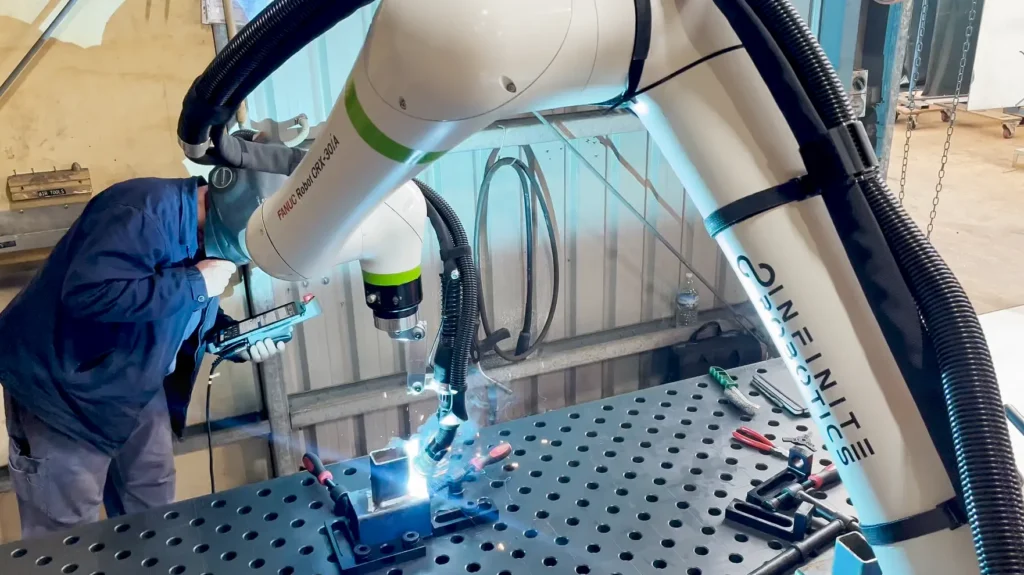
A cobot does not automatically make the complete welding application collaborative. The welding arc, hot work, fumes, sharp components, robot tooling and any positioners can still introduce hazards that require appropriate controls.
Depending on the application, the system may include:
- Physical fencing, enclosures or welding screens
- Interlocked access gates
- Light curtains or safety scanners
- Emergency stop devices and safety-rated control functions
- Safe speed and position monitoring
- Fume extraction or an interface to the customer’s extraction system
- Safety validation and supporting documentation
Not every project will require every control listed above. A quotation should clearly state what is included in the system, what must be supplied by the customer and what site works are required.
At Infinite Robotics, machinery safety is integrated into the system design from the outset under the direction of a TÜV Rheinland certified Functional Safety Engineer for Machinery. This allows the robot, welding equipment, tooling, positioners, access controls and operating modes to be assessed as one complete system rather than treating safety as an addition at the end of the project.
Programming and Commissioning
Programming and commissioning can include system design, robot and weld programming, PLC or HMI development where required, welding trials, safety validation, factory acceptance testing and onsite commissioning. Offline programming and CAD simulation may also be used where they improve reach analysis, fixture design or program preparation.
This engineering work is a genuine part of the system cost. Under-allowing for it may produce a lower initial quotation, but it can shift cost and risk into installation, commissioning and production ramp-up.
Site conditions also influence the total project cost. These can include electrical supply, shielding gas, compressed air, fume extraction, foundations, lifting access, freight, travel and the availability of production parts for testing. The quotation should identify which items are included and which remain the customer’s responsibility.
Robotic welding requires the mechanical design, fixturing, robot programming, weld process, safety system and production sequence to work together. At Infinite Robotics, these elements are considered as one integrated system because a decision in one area can directly affect reach, cycle time, weld quality, operator access and safety.
Installation and go-live processes are generally straightforward and reasonably priced, however, costs can increase if the process takes longer than expected due to unexpected issues.
What Should a Turnkey Welding Robot Quote Include?
When comparing quotations, it is important to confirm that each supplier is quoting the same overall scope. A turnkey quotation should clearly identify whether it includes:
- Robot and controller
- Welding power source, torch, wire feeder and required interfaces
- Welding tables, jigs, fixtures, positioners and external axes
- Safety system, guarding and welding screens
- Fume extraction or connection requirements
- System design, programming and welding trials
- Factory acceptance testing
- Delivery, installation and commissioning
- Operator and programmer training
- Manuals, risk assessment, safety documentation and validation
- Warranty, service and ongoing support
- Robot and welding equipment manufacturer support in Australia, including spare-parts availability and expected product lifecycle
- Customer-supplied services, site works and other exclusions
Headline prices can appear lower simply because important elements have been excluded. The meaningful comparison is the total installed scope required to bring the system into production. Buyers should also confirm who will support each major component after commissioning. A package assembled from low-cost equipment may become expensive if the robot manufacturer, welding supplier and integrator each refer problems to someone else.
Initial Training and Ongoing Support
Training and ongoing support may be included in the turnkey system price or charged separately. The quotation should clearly state the amount of training provided, who it covers and whether any ongoing software or support fees apply.
Initial training is essential to ensure the customer’s team can safely operate, program and maintain the robotic welding system. It should cover normal operation, program adjustment, weld parameter changes, fault recovery and routine maintenance.
Ongoing support provides access to experienced assistance when troubleshooting, maintenance or repairs are required. Buyers should compare warranty coverage, local spare-parts availability, remote support, onsite response and any ongoing charges—not just the initial purchase price.
Cobot Welding System vs Industrial Robotic Welding Cell: Which Offers Better Value?
Cobot and industrial robotic welding systems should not be compared on robot price alone. The better-value option depends on part size, weld access, production rate, changeover frequency, required speed and whether positioners or guarding are needed.
Although a cobot arm may have a lower entry cost, a cobot solution is not automatically the least expensive option. Once a positioner, track, engineered fixturing, extensive guarding or automated loading is required, the cost gap can narrow. In some applications, an industrial robot provides better value through higher speed, greater reach, increased payload or better integration with external axes.
| Consideration | Cobot welding system | Industrial robotic welding cell |
| Typical application | High-mix work, regular changeovers, manual loading and smaller production batches | Sustained production, higher speeds, larger components or more complex automation |
| Robot capability | Generally lower speed and payload, with easier to learn programming | Higher speed, payload and integration capability |
| Positioners and external axes | Can be added, but may reduce the cost and simplicity advantage | Well suited to positioners, tracks and multiple stations |
| Safety | Determined by the application risk assessment; welding and positioners may still require screens or guarding | Generally uses an integrated guarded cell with controlled access |
| Fixturing | May use simple or engineered jigs depending on the parts | May use simple or engineered jigs depending on the parts |
| Relative investment | Often lower for a simple system but can increase considerably as options are added | Generally requires greater integration but may deliver better production value |
Beyond Upfront Costs: ROI on a Welding Robot
Upfront cost is only one side of the investment decision. A suitable robotic welding system can create value through greater arc-on time, more predictable output, reduced rework, improved production continuity and better use of skilled welding personnel.
The question therefore changes from simply “How much does a welding robot cost?” to “What return can this investment generate, and over what timeframe?”
ROI should be calculated using the customer’s actual production data rather than general productivity claims. Important inputs include current manual welding hours, labour availability, loading and changeover time, projected robot utilisation, rework, consumables, maintenance and the value of any additional production capacity.
ROI for robotic welding equipment is generated through various factors, including:
- Labour Costs and Availability: Robot welders don’t call in sick, move on to another company or retire. They also work more efficiently than human operators, handling the repetitive tasks so your experts can focus on more complex tasks. Moreover, they’re available now and learn from your existing team.
- Productivity and Throughput: Robotic welding equipment consistently delivers more welding time with less time required for repositioning, resting, and setting up. They also produce consistent cycle times that allow for better production planning and reliable delivery.
- Weld Quality and Rework Reduction: Cobots deliver consistently high-quality finishes, reducing the risk of defects and need for re-welds. This saves time and allows for greater throughput.
- Capacity and Delivery Reliability: More predictable cycle times can improve production planning and allow a business to increase output without an equivalent increase in headcount.
Robotic welding equipment provides the opportunity to scale production now, without increasing headcount, labour costs, or sacrificing quality. This makes it a valuable investment for businesses looking to prepare for future growth.
The ROI you receive in the form of labour savings, productivity gains, reduced rework rates, and high-quality output will pay for the system quickly.
Getting a Welding Robot Quote in Australia
No two robotic welding systems are identical, so reliable budget guidance requires a basic understanding of the parts, welding process and production requirements. At Infinite Robotics, we use this information to identify the most suitable system category and the factors that are likely to have the greatest effect on the investment. To prepare an initial system concept and budget indication, we generally require:
- Drawings or 3D CAD models
- Part dimensions and weight
- Weld locations, lengths and sizes
- Material, thickness and welding process
- Expected production volumes and product mix
- Current manual welding and handling time
- Photographs of the existing parts and jigs
- Site location and available services
- Known future production requirements
With this information, we can identify the likely system configuration, the main cost drivers and whether further feasibility work or welding trials are required.
Contact Infinite Robotics today to discuss your welding needs and get a tailored quote.