Looking for the next advancement in welding to transform your production line? Cobot welding systems are an innovative system, collaborating with your team to streamline production, closing the skills gap, and ensuring consistent quality.
Whether you’re looking to transition from traditional industrial welding robots or for an accessible entry point into welding automation, cobot welding systems could be right for you. In this article, we will explore exactly what a cobot welding system is, how they work, the benefits they offer, where they fit in a manufacturing environment, and how they compare to traditional industrial welding robots.
Keep reading to discover whether these innovative systems are right for your workshop.
What is a Cobot Welding System
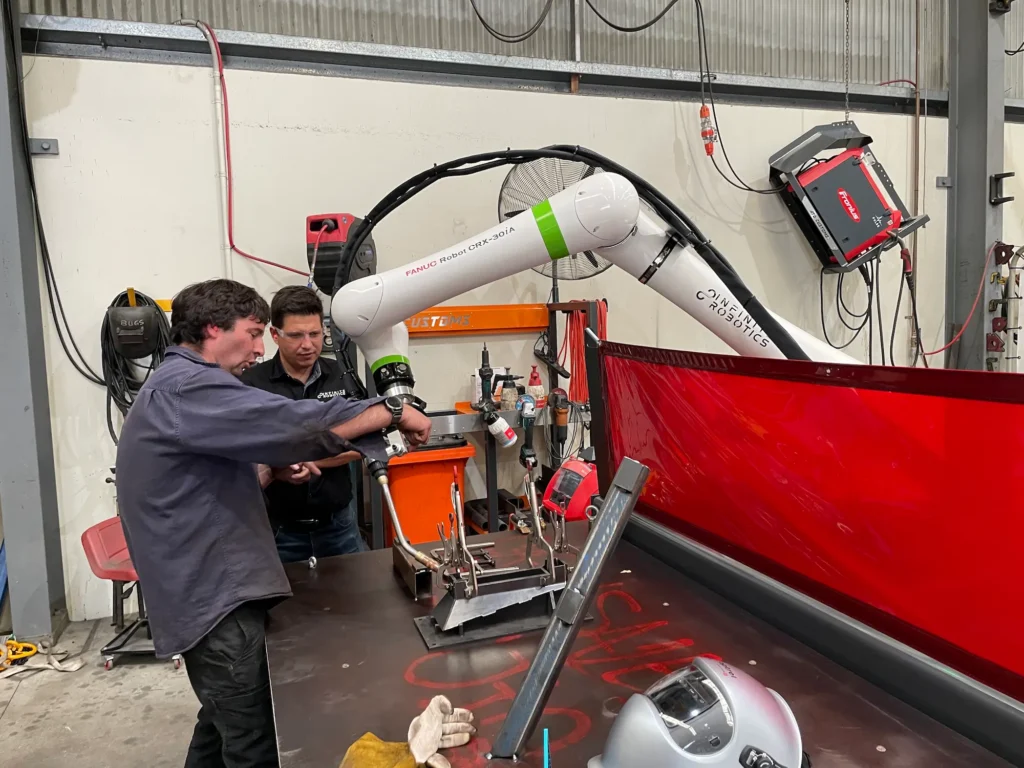
Collaborative welding robots, also known as cobots, are an innovative welding system that pairs human welding expertise with a robotic arm to automate repetitive MIG or TIG welding tasks. These systems integrate the knowledge of your best human welders and then automate their processes.
They are designed to work alongside your experienced team, handling the tedious, high-volume welds and freeing up your human operators to handle complex fit-ups and part prep. These collaborative welding robots don’t replace your team, they become a part of it, streamlining processes and improving throughput without compromising quality.
Core Parts of a Cobot Welding System
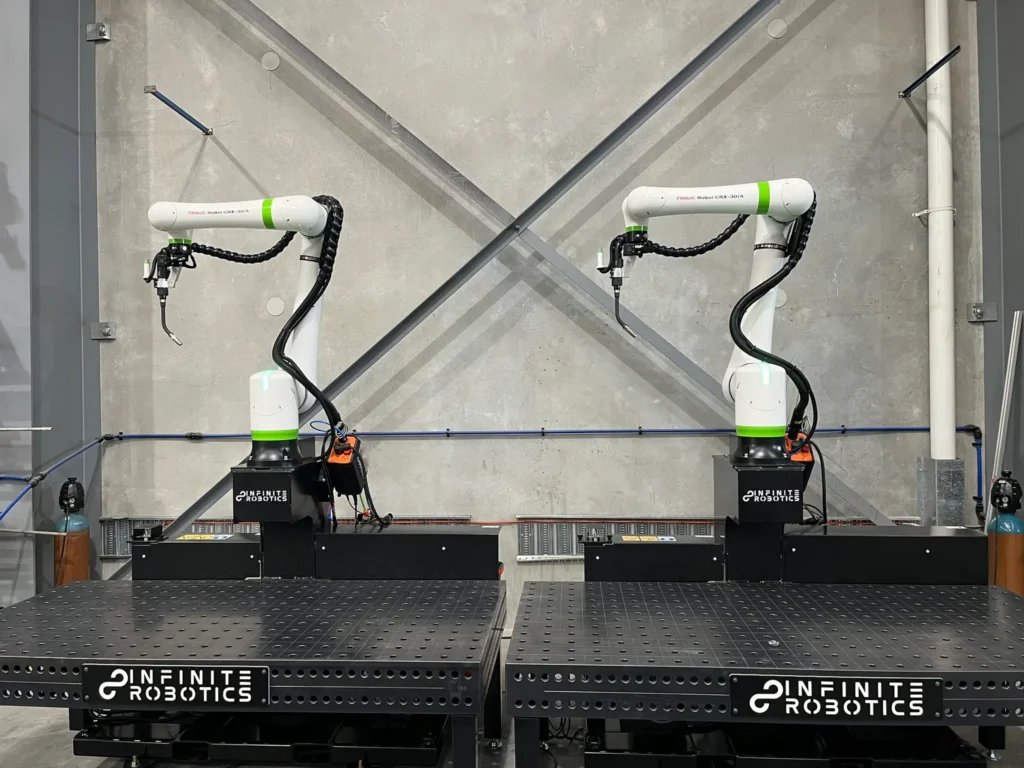
Cobot welding systems feature a range of components to enable automated welding, including:
- Robot arm — The 6-axis arm physically moves and orients the torch along a pre-programmed path with high repeatability and precision.
- Positioners & fixtures — These include automated turntables, drop-center positioners, or custom tables that secure and rotate parts, allowing the cobot to reach different angles without human intervention.
- Sensors — These are hardware add-ons that allow seam tracking, edge detection, and touch sensing, ensuring real-time adjustments and preventing misalignment.
- Welding power source — This is the core machine that powers the system, can be MIG or TIG depending on your welding requirements.
- Welding Torch — The torch is mounted to the end of the robot arm, shielding gas and electrical currents to the weld zone.
- Welding software — Advanced software allows your operators to build the code and program welding pathways for seamless operation.
- Table or fixture — This is where the robotic arm is mounted from and your material is placed for welding.
- Safety features — Cobots feature integrated safety systems and features that meet AS4024 standards.
In addition to the hardware and software that come standard with cobot welding systems, we also provide dedicated training. We empower your team with the skills and confidence they need to operate, program, and troubleshoot your system effectively.
How Do Cobot Welding Robots Work
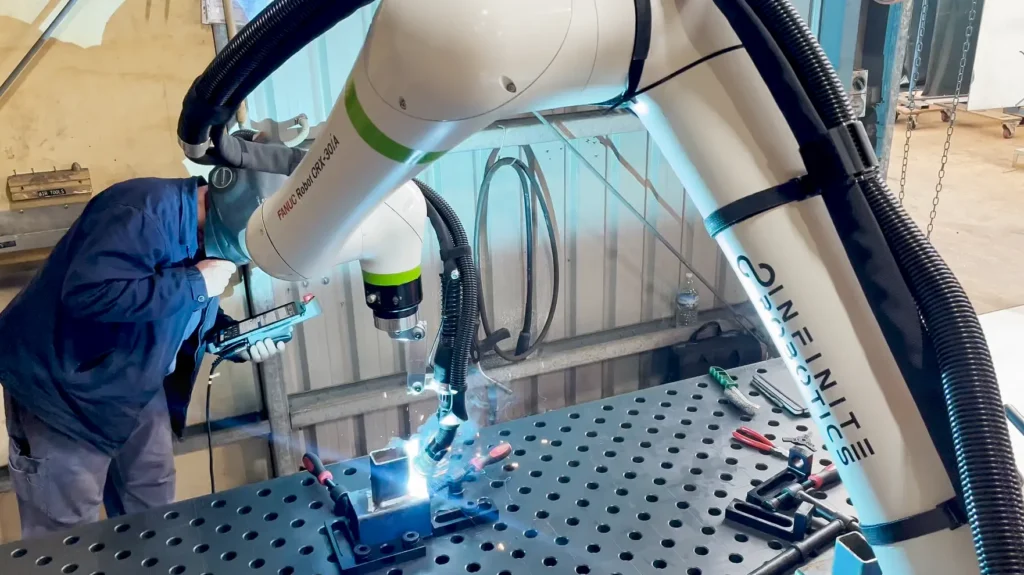
Cobot welding robots combine a maneuverable robotic arm, a standard welding machine (like MIG or TIG), and an intuitive, easy-to-use software interface to automate welding processes. Human operators load the parts and then program the cobot using a simple graphical tablet based app for seamless operation. They can input parameters, such as wire feed speed, voltage, and travel speed directly through the software, then the cobot replicates the motion. This ensures consistent speed, angle, and arclength, producing high-quality, repeatable welds.
Benefits of Welding Cobots
Welding cobots offer a wide range of benefits for fab shops and manufacturers. One of the biggest benefits of cobots is that they can help close the gap created by labour shortages. Many businesses are facing challenges in finding new and experienced welders to fill their teams and meet demands. Collaborative welding robots join your team, automating repetitive work straightaway, boosting productivity and optimising your team’s workload.
Moreover, as your operators become trained and learn how to get the most out of their cobots, they can also learn how to program the robots to handle high-mix and complex welding tasks. They develop with your team, allowing for consistent scalability without compromising quality.
Where Cobot Welding Robots Fit in a Manufacturing Environment
Collaborative welding robots are ideal for manufacturers who face high-mix, low-volume production. These systems perfectly handle repetitive tasks alongside human welders without intervention. Cobots can seamlessly switch between different parts with minimal setup. Human operators simply program the welding path and then the cobot follows the direction, ensuring continuous, seamless, high-quality welding.
These cobots feature a small footprint, requiring less space than large industrial welding cells, and are mounted on mobile carts so they can be moved to different workstations. This allows for flexibility and use in compact or busy workshops
Cobot Welding Systems vs Traditional Industrial Welding Robots
Collaborative welding robots offer an alternative to traditional industrial welding robots for diverse manufacturing workshops.
Traditional welding robots have been used in many workshops for years to handle mass production with speed and accuracy, however, they require specialised technicians for programming and significant space. Cobots on the other hand are highly flexible, portable, and easily programmed by welders after training, handling high-mix, low-volume tasks seamlessly.
Explore the table below to find the right system for your workshop.
| Cobot Welding System | Traditional Industrial Welding Robots | |
| Programming | Fast: Programmed using an intuitive graphical tablet-based app with manually guided teaching | Complex: Requires programming using text-based commands and teaching with directional buttons. |
| Production Volume | High-mix, low-volume: Ideal for frequently changing and repetitive tasks. | High-volume, low-mix: Ideal for continuous runs of identical parts. |
| Safety | High: Integrated safety sensors without the need for physical safety caging. | High: Uses perimeter fencing, safety light curtains, and restricted access zones. |
| Flexibility | High: Highly adaptable and easy to redeploy across different workstations. | Low: Confined to certain cells and requires more complex programming than a cobot. |
| Speed & Throughput | Moderate: Accommodates human presence. | High: Optimised for maximum throughput. |
| Payload | Lighter Duty: Lower payload capacity. Best for simple to moderate weldment sizes. | Heavy Duty: Massive payload capabilities for demanding, industrial repetition. |
| Operator Involvement | Moderate: Collaborates with human operators for programming and loading. | Low: Once programmed, operator involvement is limited to initiating sequences |
| Space Requirements | Low: Compact & portable design allows for movement. | High: Caged cells that feature a large footprint. |
Find Out if a Cobot Welding System is Right for Your Workshop
If you’re looking to streamline your production line, scale your capabilities, and combat labour shortages, cobot welding systems are a great place to start. Working seamlessly with your existing team to tackle the repetitive tasks without compromising on quality, these innovative systems are an accessible entry point into welding automation, offering benefits from day one.
Contact Infinite Robotics today to discuss your welding needs and discover whether a cobot welding system is right for you.