Many manufacturers have considered automating their welding processes but often come up against the same concern. Will it streamline your production line or add unnecessary complications?
Investing in robotic welding systems is a significant decision, and the gap between many offerings and the reality has left many manufacturers skeptical. This is understandable.
At Infinite Robotics, we aim to build back that lost trust. Our automated welding machines are grounded in collaboration, education, and innovation. We partner with industry leaders, combining world-class technology with local expertise to deliver custom robotic systems that meet unique needs and produce results that manufacturers can count on.
Why the Process is as Important as the Technology
World-class hardware is important, but on its own, it’s not enough to transform your production line. High-quality, reliable automated welding automation requires a dedicated delivery process from initial design to deployment and ongoing optimisation. Manufacturing processes are dynamic and the automations that sustain them need to be as well.
Many welding automation projects fail for a number of reasons, including:
● Inadequate upfront application analysis leading to misspecified systems
● Skipped simulation leading to problems being discovered at installation
● Integration gaps between the welding robot, power source, and production line
● Insufficient operator training leaving capability on the table
● Post-installation support that disappears after handover
Every one of these issues is preventable with the right process.
Infinite Robotics’ Welding Automation Process
Infinite Robotics’ end-to-end delivery process spans consultation, simulation, engineering, installation, training, and support. Our process is designed to eliminate uncertainty and ensure your unique needs are met at every stage. This ensures that manufacturers can trust that their robotic welding system will perform to the highest standards.
However, our commitment doesn’t end with installation. We offer lifetime support to help manufacturers get the most out of their investment for years to come.
Stage 1: Consultation
Every welding automation journey with Infinite Robotics begins with an in-depth consultation. Our team takes the time to get to know your welding needs and current situation, including:
● Component types, materials, thicknesses, and joint configurations
● Current production volumes and target throughput requirements
● Existing workforce, skill levels, and operational constraints
● Quality standards, certification requirements, and traceability obligations
● Facility layout, available floor space, and infrastructure
This allows us to understand the solutions that you need to meet your current demands and future targets with your current team and space.
Stage 2: Concept Design
Once we understand your needs, we then work with you to develop a clear, custom concept. Our design encompasses:
● Robot selection: We help select the right robotic arm to ensure the right reach and configuration to the specific geometry and access requirements.
● Welding process selection: We choose the right power source technology for your materials, joint types, and quality requirements.
● Positioner and fixturing concept: We then design the part manipulation strategy that presents every weld joint to the automated welding robot in the optimal position.
● Cell layout concept: Finally, we consider the spatial design of the full robotic welding system within your facility.
This concept also outlines how the suggested design will translate into commercial terms. This allows you to evaluate the estimated cycle times, throughput projections, costs, output quality, and ROI. We collaborate with you to address potential concerns and tweak the design as necessary to meet your needs before starting any work.
Stage 3: CAD Simulation and Engineering Validation
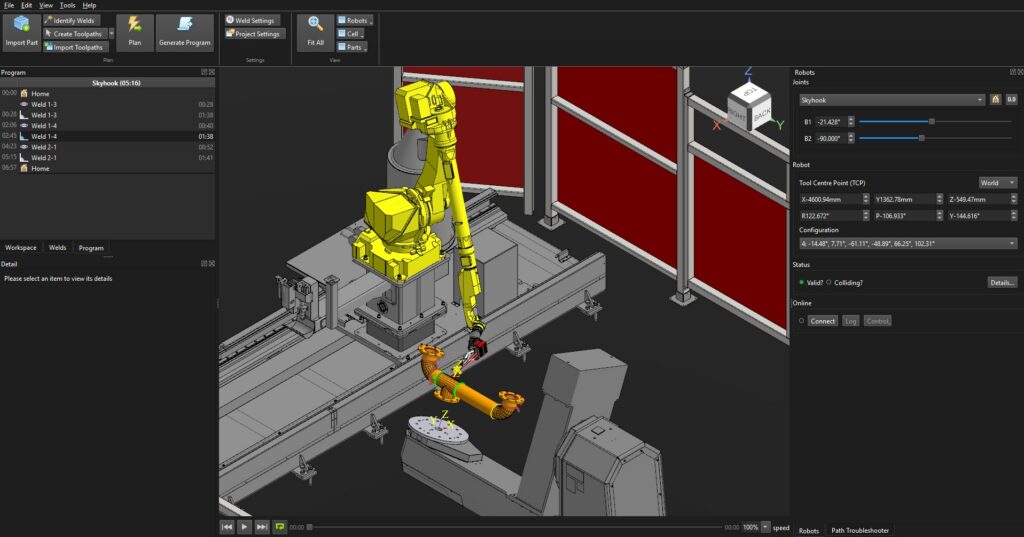
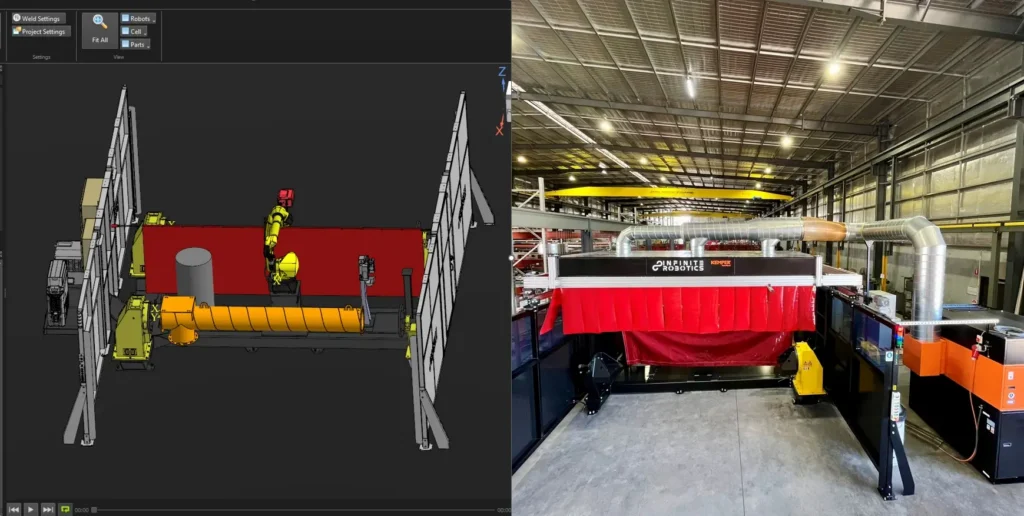
Before we touch any hardware, we build a simulation of the robotic welding system design. This allows you to visualise what the welding cell will look like and how it will work. The simulation includes:
● Accurate CAD models of the robot, positioner, fixtures, and tooling
● Part models representing the actual components to be welded
● Verification of reach, clearances, and torch accessibility across all weld joints
● Safety zone and guarding design validated against the full robot motion
● Simulated weld pathways for single and multi-pass weld sequences and collision detection
● Estimated cycle times for positioning and welding
These detailed simulations allow you to see what you’re getting before it’s built and allows us to make further improvements as necessary to ensure the best welding automation for your needs.
Stage 4: Assembly
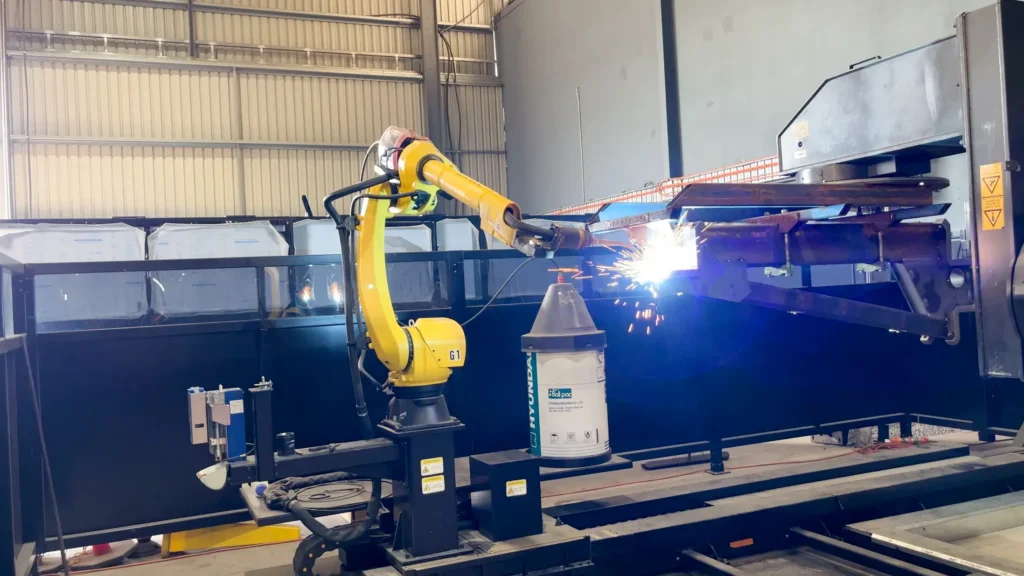
Once the design and simulations are signed-off, we then begin building your robotic welding equipment. Using robotic systems and automation technology from world-class companies, such as FANUC, Fronius, and Kemppi, we assemble modular robotic welding systems in our facility. We then program and rigorously test the system for quality control, ensuring that it meets the highest standards.
Stage 5: Installation
We then coordinate delivery to your facility for installation. We provide a fast, seamless onsite installation experience that ensures minimal disruption and stress. The innovative, modular design allows for simple transport and efficient assembly on-site, resulting in welding automation that performs from day one.
The same engineers and technicians who designed and built your system are the same ones who install it, this ensures that every detail is executed perfectly, and any questions or adjustments can be addressed on the spot.
Stage 6: Operator Training
Once the robotic welding system is installed and up and running, our experts will provide hands-on training. We believe that efficiency of your system depends on the expertise of the operators using it. So, we take the time to provide practical training that empowers your team.
Our structured, on-site training program builds incremental knowledge from key concepts and integration to programming and troubleshooting. This ensures that your team is confident to get the most out of your system. We also provide customised training materials that your team can refer back to as necessary long after the training is complete.
Stage 7: Ongoing Support
Even after all that, we still don’t leave you on your own. Even though your operators should now be confident to handle everything, we still stay by your side to provide support when you need it. Our local team delivers timely support with no delays or hidden costs.
Whether you need assistance with troubleshooting, adapting your system to your evolving needs, or ordering replacement parts, we offer swift, reliable support. Our team can help solve quick fixes, complex issues, and order spare parts from local warehouses to get your welding robot back up and running as expected sooner. Thai ensures quicker resolutions, less downtime, and greater productivity.
Embrace Welding Automation with Confidence
The quality of a robotic welding system is determined not just by the technology but by the process used to design, engineer, integrate, install, and maintain it. At Infinite Robotics, we offer a tailored, end-to-end process to eliminate uncertainty and ensure that your needs are addressed at every stage.
From initial consultations and simulations to installation and lifetime support, we deliver service that you can trust. Investing in welding automation should not be a leap of faith, it should be a strategic decision built on collaboration, education, and testing.
Contact Infinite Robotics today to discuss your welding needs and start the ball rolling on a robotic welding system build that could transform your production line.