In the current working environment, with workforce and skill shortages and growing demands, the question about whether to automate has been answered. For most manufacturers it’s a resounding yes. But now there’s a harder question: What kind of automation is right for your production line and workshop?
Cobot welding and robotic welding systems both offer solutions for the skills gap and productivity challenges, but they are not equal. Choosing the right automated welding system is essential for ensuring you make a smart long-term investment that streamlines production effectively and compounds over time.
Making the right choice between cobot welding and a full robotic welding system is not just about which technology is better, it’s about which technology is better suited to your specific workshop’s production profile, workforce, and growth trajectory.
Keep reading to discover which system is best suited for your workshop.
What is a Cobot Welding System
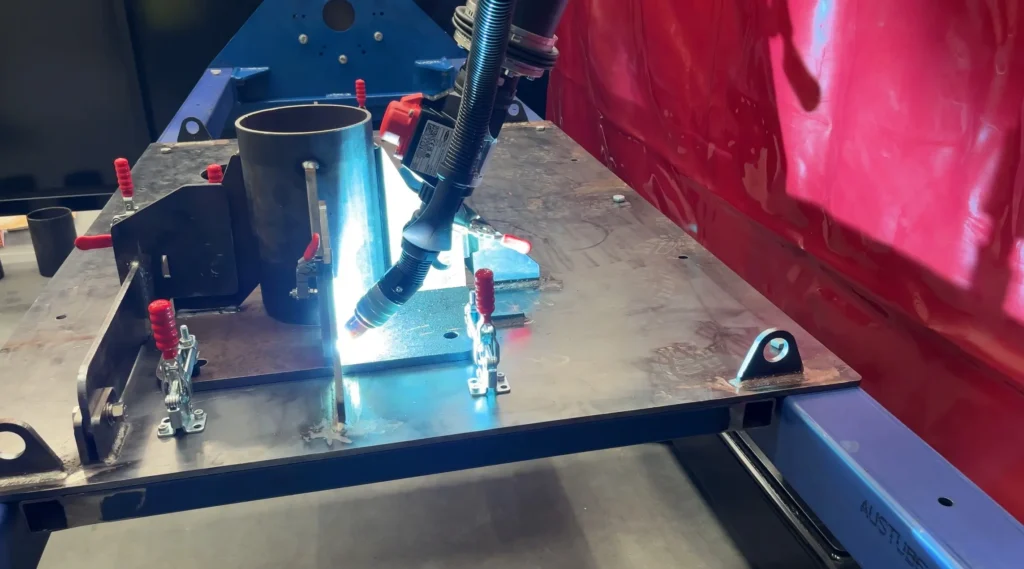
Cobot robot welding systems, also known as collaborative welding robots, pair human welding expertise with a robotic arm to automate repetitive MIG or TIG welding tasks. These innovative systems work alongside your team, integrating their knowledge to handle the tedious, high-volume welds. This frees up your human operators to focus on complex fit-ups and part prep.
As a rule, cobot welding systems are generally more flexible, compact and easier to program. This makes them a great entry point to welding automation, while also offering long-term benefits for high-mix, low-volume production. When you choose to add a cobot to your team, you will receive dedicated training to ensure your team knows how to get the most out of the system.
Cobots are designed to join your team, automating repetitive tasks from day one, boosting productivity and optimising how your operators work, while requiring a small footprint and minimal specialised knowledge.
You can read more about what cobot welding systems are and how they work in our previous article here.
What is an Industrial Robotic Welding System
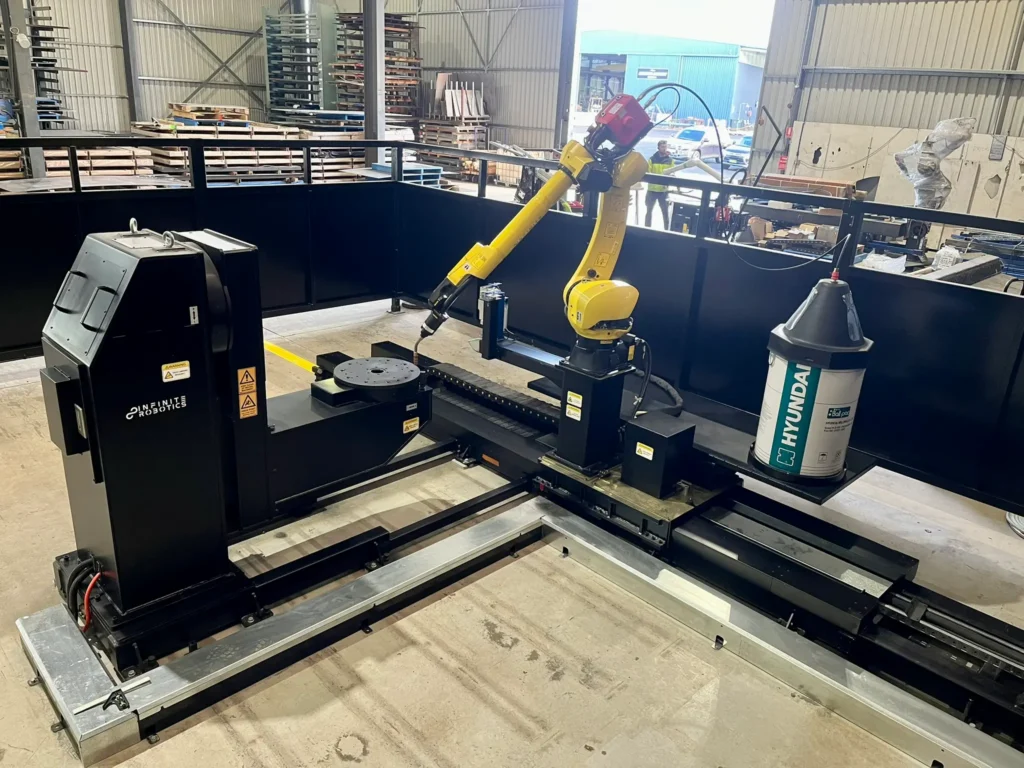
Robotic welding systems integrate an industrial welding robot with a dedicated welding power source, positioner, fixturing, and a fully guarded safety enclosure. These systems typically feature a 6-axis articulated arm that offers a higher payload, reach, and speed than a cobot. This makes them best suited for high volume, large components and complex production requirements.
In order to handle large components safely and effectively, they require a large footprint and safety enclosure. This makes them ideal for large productions, but can be a challenge for smaller facilities.
Unlike cobots that work alongside your team, robotic welding systems work autonomously with limited involvement from operators, freeing them up to focus on more complex tasks once the sequence is initiated. This allows for maximum throughput, handling large, continuous, and repetitive runs with minimal input from your team.
Cobot Welding Systems vs Robotic Welding Systems
Cobot robot welding systems are a flexible, compact, and easy to use solution for manufacturers looking to streamline high-mix, low-volume production and bridge skill gaps. Traditional, industrial welding robots, on the other hand, are better suited for complex production lines with higher volume and larger components.
Both are great options for different workshops, but the right choice for you will depend on your production requirements, team, space availability, and future growth expectations.
Explore the table below to find the right system for your workshop.
| Cobot Welding System | Robotic Welding Systems | |
| Cost | Moderate: Lower initial cost for cobot hardware. | High: Higher initial capital investment. |
| Footprint | Low: Compact & portable design allows for movement. | High: Caged cells that feature a large footprint. |
| Safety | High: Integrated safety sensors without the need for physical safety caging depending on the application and risk assessment. | High: Uses perimeter fencing, safety light curtains, and restricted access zones. |
| Programming | Fast: Programmed using an intuitive graphical tablet-based app with manually guided teaching. | Complex: Requires programming using text-based commands and teaching with directional buttons. |
| Production Volume | High-mix, low-volume: Ideal for frequently changing and repetitive tasks. | High-volume, low-mix: Ideal for continuous runs of identical parts. |
| Part Size | Small: Best suited to smaller, lighter components that can be positioned within the cobot’s work envelope without heavy positioner equipment. | Large: Can handle a wide range of payload and reach configurations from medium-sized components to large structural fabrications. |
| Weld Complexity | Low: Performs well on straightforward joint types, such as fillet welds, simple butt welds, and single-pass applications. | High: Ideal for complex welds requiring adaptive seam tracking or real-time process adjustments. |
| Operator Skills | Low: Accessible programming makes them a practical option for workshops where the workforce has strong welding knowledge but limited robotics experience. | High: Accessible with appropriate operator training, but deeper programming and fault diagnosis capability is required. |
| Offline Programming Capability | Can be implemented to support offline operations and enhanced efficiency. | Can be implemented to allow operations to continue offline and maintain efficiency. |
| Scalability | High: Highly flexible for variable product mixes and production requirements and can be reprogrammed and redeployed relatively quickly. | High: Additional cells, robots, and extended shift patterns can be added as demand grows without significant infrastructure changes. |
Common Welding Automation Misconceptions
There are a number of common misconceptions that impact how manufacturers view cobot welding and robotic welding systems, including:
- “Cobots are always cheaper” — While it is true that the hardware for cobot robot welding costs less upfront, the total cost of ownership over time can be higher depending on the layout, options and application. Additional guarding such as perimeter fencing and light curtains are required if the cobot is used with positioners or laser welding.
- “Industrial welding robots are only for very large factories” — Industrial welding robots have a large footprint, making them better suited for large factories, however, they can be deployed by small and medium manufacturers if the volume and part size requires them.
- “Cobots are easier to program than industrial robots” – This can be true, if no training or support is provided by the integrator. The tablet based teaching and manual guided teaching methods available for cobots is very accessible for new users, however the powerful and intuitive text-based instructions on the industrial robots can be just as easy to use.
- “Cobots are always the starting point for automation” — While cobots are often positioned as a great entry point for welding automation, they can be implemented at any time, even alongside robotic welding systems. Similarly, manufacturers can choose robotic welding systems as a first investment if their needs are better suited to them.
- “Cobot welding is just a stepping stone to full robotic welding systems” — Cobot welding systems can be the right long-term solution for workshops with high product mixes, shorter run lengths, or space constraints.
- “Welding automation reduces the need for skilled human workers” — While automated welding systems can help bridge skill gaps, there is still a critical need for skilled welding professionals. Cobots and robotic welding systems work alongside skilled teams integrating knowledge and handling repetitive tasks while human operators tackle the more complex tasks and prep.
Find the Right Welding Solution for Your Workshop
Welding automation offers a solution to streamline production, scale capabilities, and combat labour shortages, but making the right choice is crucial. Cobot welding and robotic welding systems both have benefits and limitations for different workshops. The right choice won’t be which has the best tech, but instead which is best suited for your workshop, production needs, and future growth expectations.
Contact Infinite Robotics today to discuss your welding needs and find the right system based on your workshop, not just the robot type.